Showing posts with label speakers. Show all posts

Tuesday, August 29, 2017

Culinary Hall of Fame and the Ultimate Time Capsule

composite picture of Culinary Hall of Fame Executive Chef Jess Barbosa at the Marriott Muehlebach Tower in Kansas City.
Executive Chef Jess Barbosa
enters Culinary Hall of Fame
'I wanted to be somebody', fondly remembered retired Kansas City executive chef Jess Barbosa from his childhood years as a 'poor Mexican kid on Kansas City’s West Side'. He has indeed come a long way.
On June 30th, 2017, the Kansas City Star reported on Chef Barbosa's recent induction into the American Academy of Chefs’ Culinary Hall of Fame. On July 11th, 2017, Mr. Barbosa, 84, achieved a lifelong dream. His peers at the American Culinary Federation recognized his long body of work during an induction ceremony in Orlando, FL..
To me, Chef Barbosa is both, a man of great integrity and stature and my friend's dad. Yes, Chef Barbosa is Chuck Barbosa's dad.
Visiting Chuck's house during the 90s was great. I remember a home full of love where Chef Barbosa was the unbreakable foundation while Mrs. Barbosa was the sweetness that made all blend incredibly well. It goes without saying that Chuck and I were trouble. But no matter how far we pushed boundaries,  Chuck's parents were always welcoming.
So, as I serendipitously found the article about Chef Barbosa's well deserved recognition, I had to share the moment  with the world. I am so proud of Chuck's dad.
picture of autosound World Champion Chuck Burbosa next to his award winning Plymouth Laser
Suave!
But the apple doesn't fall far from the tree. World Champion Chuck is a guy with enormous internal strength and great moral compass. Yes, Chuck still has a long road ahead to reach much success as his dad has. I am nonetheless confident that his fundamentally sound strengths will take him in the right direction.
For today, though, I just want to celebrate. I want to reach out to his dad and want to enjoy looking back at yet another article on Chuck's car. Why not double dip?
By the way, did you hear that Chuck is selling his car? While the installation is probably different than the one in the following pictures, it is surely world class. After I left the US, Chuck went on to win anything there was to win during the late 90's. Then, hoping for a renaissance Chuck took his car to Gary Biggs. As bad luck would have it, the project never progressed due to a dozen different difficulties. So now, almost 20 years after a wonderful golden era, Chuck has reopened his time capsule and is making it available to anyone wanting to own a piece of history.
Picture of Chuck Barbosa's award winning red Plymouth Laser
Chuck Barbosa and his Plymouth Laser 
have learned from mistakes. 
Nowadays few mistakes are made.
If you are interested on buying his car, write a comment to this article. Include your contact information. I will then communicate with you with a way to reach Chuck. Your comment will not be made public. Your personal information will only be shared with Chuck.
And now, the article from a once-in-a-lifetime magazine issue. Enjoy!


Mutual Competitor
Mobile Sound Competition '96 Annual 
Staff Writer


Picture of Chuck Barbosa's award winning red Plymouth Laser's engine compartment
A totally detailed engine compartment 
makes this look like a trailered car, 
when in fact it is driven daily.
Mutual funds representative Chuck Barbosa has made many attempts at a successful competition season. Since he first got going in 1991, several different people, shops and installations have gone into creating what is now a very viable Plymouth Laser IASCA and USAC competitor.
Picture of Chuck Barbosa's award winning red Plymouth Laser's interior
A Pioneer ODR system operates the rig
from the cockpit without Chuck's having to
take his eyes off the road.
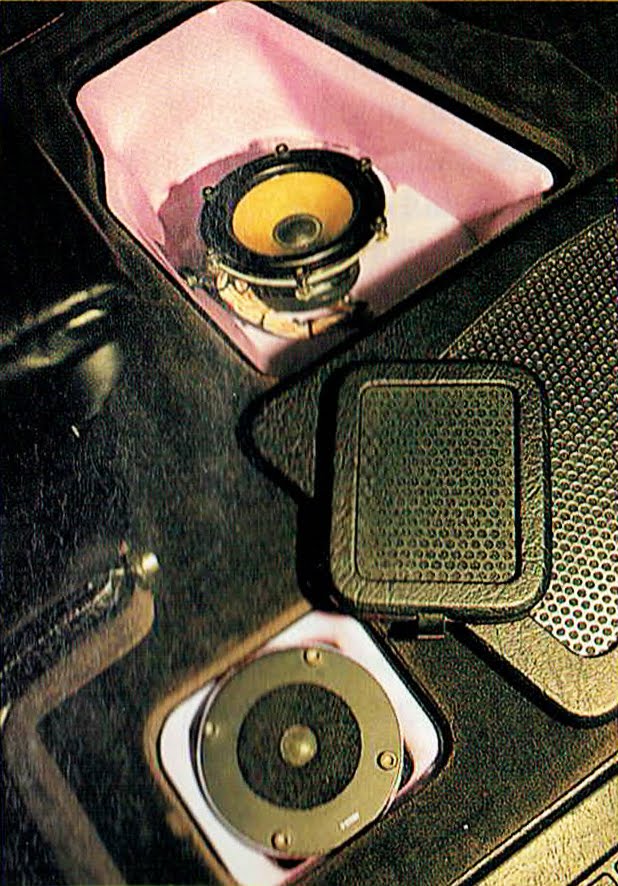
Chuck took advice from judging duo Chris and Melissa Owen, who suggested moving away from door-and-dash mounted speakers and trying kick panels. The suggestion was strange sounding to Chuck at the time and just as foreign to his installers. However, after listening to pro-competitor Alberto Lopez's sweet-sounding Sentra with its kick panel locations, Chuck went for it. This was his first step in a series of metamorphic stages before the real fun started.
Picture of Chuck Barbosa's award winning red Plymouth Laser's trunck
A very well put together rear hatch
looks invisible with the pieces in place.
As pictured, it has "world-class" written all over it.
With the new-found help of Pepe and Alberto Lopez of Stereo West, Chuck found himself moving from a top-five competitor to a best-off-show regular. Most recently, he won the best-off-show at the 1994 IASCA triple point MidWest Show-down held by Audiosmith. At the same event, he also scored best Sound Q and best Sound Q Plus -a category in which Chuck suffered most in previous installs. It is the kind of winning success that enabled Chuck to earn over 70 points for the '95 season. Chuck likes to point out that he not only found a great installer, but a great friend, too. Alberto Lopez, as has been both for him throughout competition -even when the chips were down.


image of Mobile Sound Competition's  Annual '96 Winners Edition  cover page
Mobile Sound Competition's
Annual '96 Winners Edition
cover page
image of Mobile Sound Competition's  Annual '96 Winners Edition  page 96
Mobile Sound Competition's
Annual '96 Winners Edition
page 96


Monday, August 14, 2017

Great Britain; a Special Place

Great Britain has as very special place in my heart. It was by chance that I went to work there and it was wonderful to see the Brits open their arms to me.
I really didn't know anything about England, so the arrangement was simple. I would get an airplane ticket there and back, a place where to stay for a month, food and transportation but no pay. In exchange, I would show my ability to bring value to Car Audio Products while making sure that the prearranged salary would be enough to live there comfortably. If I liked it and they liked me, I would stay. It was a low risk arrangement between my potential employer and I.
Outside of knowing they would speak English, I had no other expectations about the United Kingdom. But oh, what a wonderful place I found and how magnificent their people.
I got a chance to see how uniquely individual and innovative the Brits are. The fact that they live on an island separated from the rest of Europe suits them quite well. They are European, but not quite so. They operate one of the most sophisticated economies in the world but in a unique way. While most of the world designs cars where your left hand hangs out the driver's window, the Brits do so for the right hand; perhaps because that's where a proper knight would carry its fighting lance. While historically great countries like France folded as soon as German tanks rolled over the border, Great Britain stood its ground after the largest and most insane bombardment any country has ever experienced.
Yes, Britons are quite special. Their confidence and a strong sense of identity means that they are hardly bullied. So when loud Americans show up to their shores to treat them as inferior, things are sure to go amiss. As soon as I landed in London, I began to hear about all the other Americans who preceded me. I heard about the many who pretentiously went there to educate the residents. I also heard about the reality check these poor souls went through. The Brits happen to be extremely creative master-craftsmen who can take on any installer anywhere. Never confuse their politeness as a sign of weakness.
Thankfully I'm everything but pretentious. The many who know me can attest to that. Yes, I play hard, but I always let the results speak for themselves. If I lose, I learn my lesson. If I win, I share the pleasure with others. So, when the industry people realized that I was not a typically boastful American, they warmly opened their hearts. They adopted me. In fact, my ability to perpetually wear shorts during even the coldest days made me an honorary Scott; you know, those guys that wear the skirt-looking kilts with no underwear while in battle as a way to intimidate opponents.
To this day, the strong ties I built remain robust. Paul Richardson, the guy I built the van with, calls me every time he comes down to Florida to take his kid to Disney parks. So we spend time together quite often. Besides having an incredible family, Paul is a great guy.
When we built the van together, I knew people would start picking apart what I did from what he did. The van was so revolutionary that it was natural for people in England to doubt that one of their own was responsible for it. But the truth is that I learned as much from Paul as he did from me. Yes, he did more of some things, while I did more of others. But we told people who asked that Paul did the left side of the van while I did the right side. "Draw a line down the middle of the van" we told anyone who asked. We simply refused to let anyone separate our work. As far as we were concerned, we worked equally hard throughout the whole process of creating this masterpiece.
The fact that I gave Paul so much respect for his hard work made everyone in the industry see that I was not the typical American. I was the brother of an Englishman. And that is how I want to remember it all. The United Kingdom is my home for me to visit my family whenever I am in the area. I'm endlessly thankful to the Brit nation.

By the way, fell free to read the previous articles about this van:

Following is yet another article about the van. This time, though, it is the super successful Max Power Magazine doing the honors. Enjoy!


Max Power Magazine December 1997
ICE CARS
Demolition Van
Words: Proby
Photos: Fly


This van is so loud it can turn a beautiful 
stone house into a pile of unsightly rubble
Take one ICE install into the sound off? Not anymore, why don't you take three and demolished the opposition?
This van is it. It's the end. After featuring this we may as well not featured another Pro ICE install ever again. This is the ultimate in ICE and I doubt anyone will have the time or cash to do it all again. I read the spec sheet and it all became clear...
'At the outset, we wanted to create the ultimate van. A huge budget was fixed in a time limit set. As the project moved on, we blew the budget and forgot about time.'
This van is everything you could ever want from ICE on wheels. It's a boomin' SPL contender, but it's got a slappin' sound quality (SQ) install and it's got a system to make your mouth water when you're cruisin'. Three systems in one van? You might think I'm taking a piss, but oh no.
The two stars of the show are installed tricksters Alberto and Paul. They put it all together —first using the might of hammers, welding torches and angle grinders and then with the finesse of magnifying glasses, watchmakers tools in the steadiest hands in the bizz.
This van has the ability to demolish your bowels with its deepest SPL spank and yet delight you with the clear tones of SQ.
Let's start with the sound quality install. The system is mounted into the Yank tank's floor and has a total of six speakers —a pair of tweeters, a pair of 5in mids in a pair of centrally mounted 8in bass speakers. These are all Eton components, but some have been modified —like the tweeters, which had been stripped and had the internals drilled to smooth out the airflow and then stuck back together for the ultimate sound. At the extreme, but then you have to listen to the damn thing to realize how well it works. I sat and listened to Yellow—The Race and he felt like I was there, in the studio, listening to the guys recording the whole thing.
There's so many mods to this van, we could spend a whole issue just talking about it. Tricks like using multiple wires to pump sound to the speakers actually work and reduce noise. The cooling system for the rear amp racks blow more like our air conditioning at the height of summer.
The perspex speaker mounts for the SQ system are unbelievable and are completely perfect and blemish free. I've seen install guys have more trouble with vinyl and these guys had with this inch thick perspex.
And what about that power supply? Running four 1200W amps for SPL is going to draw more current than a bumper episode of Coronation Street. You won't be surprised to learn that he took 7 hefty blokes to lift the battery rack into position. Even then, it was only lifted about three inches at a time, using bricks to hold it up. Jeeze. Sadly, we can talk about all the details, so you'll have to trust me to pick out the best parts. Hey, trust me!
You could be easily excuse for losing the head unit. That's 'cos there isn't one, not in one piece anyway. That Fujitsu Ten unit was stripped, slaughtered a mounted all over the van's cabin. Sure, the display is behind the perspex panel in the dash, but the CD player itself (just the mechanism and the gubbins) is practically in the floor. Tiny cables have been attached to the controls and, via a set of relays, control the unit through the armrest-mounted panel. This itself has been screen-printed with a host of it easy-read symbols. It's all designed for ease of use, but changing a CD on the move could end in tears as you have to bent double.
The SPL content of this van is extreme. Pact between the front seats and the rear battery rack are 16 of Earthquake's LS-15 subs. These are mounted in a twin-diamond arrangement and are activated by a the massive bank of dash-mounted switches, while four 1200W Lanzar amps pump up the volume to a head-splitting level.
To activate SPL mode you have to set the van up. Strap on the screen bars, lock down the doors, plug-in the external head unit and equalizer and it's time to step back. Boom? Damn right it does. It booms enough to make the alarms on cash machines go berserk, and that normally takes an attack from JCB. When the police turn up a couple and start asking questions, the demolition van switches from SPL to SQ and stealthily slides away. A class act.


Ice Spec
In-Car Entertainment's ICE Van


System Diagram
SOUND SOURCE: SQ and Cruisin' systems —Fujitsu Ten CD/tuner stripped and dispersed around the dash with external switching; SPL system—external Alpine 7909 (yes, a real old 7909) CD/tuner with Hifonics Callisto EQ, all mounted in a drum stool (Eh? —JS)

AMPLIFICATION: SQ and Cruisin' systems —2x modify the Earthquake class 'A' 2x30W amps; SPL system—4x Lanzar OPTi-50c.

PROCESSORS: Some

SPEAKERS: SQ system —2x modify Eton tweeters, 2x Eton 5in mids,2x Eton 8in subs; Cruisin' system —15x Lanzar tweeters, 8x Earthquake 5in mids; SPL system —16x Earthquake LS-15 subs

CABLES: Stinger cables throughout the system

POWER SUPPLY: Switchable twin alternator system to feed the front and rear battery racks as necessary

CAP: lots

INSTALLED BY: Tricksters Paul and Alberto

NICE IN STILL BITS: The microwave switching sensors, the Kenlowe fan for the ventilation system, the Chevy engine, the perspex, the tits on the side of the van... Basically, the whole damn thing is bad as bad can be

PERFORMANCE: Well what do you think, huh?

THANKS AND FREE PLUG: Paul and Alberto for a magnificent install; Mark at In-Car Entertainment on 0181 743 5533


Max Power Magazine Cover
December 1997
Max Power Magazine Pages 54 & 55
December 1997
Max Power Magazine Pages 56
December 1997


Thursday, August 10, 2017

From Mississippi to Nebraska

Surprised, I said "what the hell are you guys doing there?" I opened the garage's overhead door when I saw the two guys who had just left their car for me to work on the day before. This was a custom installation that would take many days. So when I saw the them coming out from behind a tree, in the middle of the Nebraska winter, at seven in the morning, I was stunned to say the least. The two guys told me they had slept outdoors the night before. "The whole night?" I asked. They went on to explain that they had no money left for a hotel. These guys had come from Minnesota for me to work on their car and had spent all the money they had on my work. I couldn't believe it.
I know it sounds crazy. So if you don't believe it either, I don't blame you. But the truth is that, during the golden years at Stereo West, I had people come from very far away. They were looking for help. While some needed complete installations, the best and most notable vehicles needed my help for two things: either eliminating noise or completely overhauling their sound performance. These special vehicles already had elaborate installations by some of the best craftsmen in the industry. Yet, my reputation for having the understanding of the physics behind sound quality and for sporting a pair of golden ears, meant that I got an exclusive opportunity to peek behind the scenes of incredible sound systems.
picture of John Stubbs in front of his 1993 Toyota 4x4Such was the case with John Stubbs. I guess he had taken a sabbatical from the police force in Mississippi  to come to hang out with us to Nebraska. It is very easy to like John. He's an honest, transparent, and charismatic guy with a great sense of humor. The time we spend together was very memorable indeed.
Before heading our way, John had the guys at Pro Audio in Mississippi build an incredible instal for his truck. The system had the USAC solid construction blended with the IASCA beauty. But many trucks are notably difficult for good sound quality performance; especially those where you stuff a huge woofer box behind the front seats.
This was a different era in sound quality. The midget-sized-instruments on top of the dash that are so common today were not acceptable back then. Today, poor judging describes such affect as good imaging specificity. Back then, we just called it what it is: funny midgets on the dash; not real music.
picture of John Stubbs' kick panel inside of his 1993 Toyota 4x4, with protective grillsWe were looking to achieve large, realistic images over a well-defined stage. While kick panels can get you close, there is only one kick panel layout that takes into consideration the low-pass  phase-lag created by crossovers. If you look close at most of our competition cars, you will see such magical layout. I once looked into patenting it before I realized it would be expensive with no reward from the effort. I believe that the only other high profile competitor ever to use a similar setup was Chad Klodner in his incredible red Mustang.
picture of John Stubbs' kick panel inside of his 1993 Toyota 4x4, without protective grillsAfter changing his front stage for our magical kick-panel set up with built in a-periodic enclosures behind the mids, the mid-bass image kept giving us trouble. Mathematically, it takes only a simple calculation to see that midbass in the doors will tend to cancel with a wide 'Q' centered around 250Hz.
picture of John Stubbs' door panel inside of his 1993 Toyota 4x4, without protective grillsSo I decided to borrow a positive characteristic of waveguides: energy dispersion control. I theorize that mounting the midbass drivers backwards would make their sound disperse in a similar fashion to convex domes with phase plugs in front of them.
picture of John Stubbs' door panel inside of his 1993 Toyota 4x4, with protective grillsEveryone remembers the 3/4" titanium MB Quart domes that could produce 20kHz in any direction. I used to say that you could point them to the toilet and still get 20KHz on the RTA. Their performance results from their phase plug redirecting energy omnidirectionally. I was hoping that the magnet structure would do the same to the back of the cone of the mid-bass drivers in the doors. Incredibly, while the effect wasn't absolutely perfect, it did a very good job. It was the best midbass set up I ever did on a door.
Yet, I must admit that I never again placed midbass speakers on the doors. I have a hard time settling for almost good enough. At the end of the day we all learn from what we do. I loved working in John's truck. Looking back, I can comfortably say that I feel privileged to have met him.
Following is a transcript of the feature article on his struck as it appeared in the annual '96 edition of Mobile Sound Competition. Enjoy!


High Roller
Mobile Sound Competition '96 Annual 
Staff Writer

picture of John Stubbs' 1993 Toyota 4x4When you think of USAC competition, think of John Stubbs of Florence, Mississippi. He and his 1993 Toyota  4x4 have been making quite a ruckus the last few years in USAC circles, and it looks as though he's ready to make more noise in '96.
When John first got started in a Novice competition in 1992, he knew that this was his gig. He teamed up with US AC competition masters Pro Audio in Richmond, Mississippi, to integrate a no-holds-barred competition system that later proved to be the ring leader.
picture of the back of John Stubbs in front of his 1993 Toyota 4x4, with motorized back window open and motorized amp rack open
John Stubbs diamond-plate "toolbox" houses four amplifiers 
—two Kicker 200si's and two 50si's.
A seemingly simple equipment layout was chosen with components from Clarion and Kicker. Clarion's Pro Audio 7770 was installed in the dash and sends its signal to a Clarion 920 EQ in-dash 9-band equalizer. Two Kicker 200sI and two 50si amplifiers were installed in the bed of the truck in what appears to be nothing other than a simple, diamond plate tool bin. A look inside, however, reveals that it is a center of electronics and amplification.
picture of behind the seats inside of John Stubbs' 1993 Toyota 4x4 truckWhile you're looking in that area, look at what lurks on the cabin side of a motorized sliding back window: Kicker SoloBaric 12-inchwoofers highlighted with red neon are sure to get the attention of any judge. Another attention getter is a unique installation of the mid-bass drivers in the doors. Kicker R-4 speakers are mounted backward in the hope of reeling in a couple of extra creativity points. The sound isn't affected by this arrangement, according to John, since the basket is "open" and the build-outs are non-obtrusive.
John's hard work earned him a runner-up award at the 1994 USAC Finals and both the highest IASCA regional and USAC national points leader in 1995 —in all totaling nearly 50 trophies in a few short years. Though a team to be reckoned with, John has decided to part with his "toy" after the '95 USAC Finals to build something new with installers Greg Pauley and Alberto Lopez of Stereo West. In the meantime, you can expect to see John at the events —judging and being his usual enthusiastic self about this great sport.


Image of cover page of Mobile Sound Competition's Annual '96 Winners edition
Cover of Mobile Sound Competition's
Annual '96 Winners edition


Image of page 46 of Mobile Sound Competition's Annual '96 Winners edition
Page 46 of Mobile Sound Competition's
Annual '96 Winners edition
Image of page 47 of Mobile Sound Competition's Annual '96 Winners edition
Page 47 of Mobile Sound Competition's
Annual '96 Winners edition


Wednesday, July 26, 2017

Couldn't have happened to a nicer guy.

picture of Dustin Culton and his 1990 Red Honda Civic
Dustin Culton and his '90 Honda Civic
And suddenly catastrophe happened. This wasn't the first, nor the last time that one of our team cars had been stolen. Doing incredible car audio made is immediately recognizable and gave us great notoriety. I once took my Sentra to the Nissan dealership for a checkup and the service guy asked me if I had a system in it. He then followed on to tell me that Alberto Lopez had already designed a system for his car and would soon start doing it. I then asked him if he knew who I was. He replied with a question and an embarrassed look: you are Alberto Lopez? Yes, a never met the guy before, but I had somehow designed a system for a car I had never seen. It was funny.
picture of Dustin Culton's 1990 Red Honda Civic's engine compartment
A beautifully clean engine compartment
But with the accolades came the constant threat that our vehicles could be vandalized or stolen. Many outside of car audio may not immediately understand that the worst people among the bad guys love great car audio. So it was always a matter of time before one of us in the team would let their guard down in a car would be stolen. But this couldn't have happened to a nicer guy. When Dustin told me that his competition Civic had been stolen (read here about Dustin's previous system), he was heartbroken. Thankfully he had great insurance and some savings. So, as soon as the claim was settled, Dustin started on his next project.  He knew exactly what he wanted; from the type of car, to the color, to the audio equipment brands, to the overall fit and finish. Dustin was a mad man with a mission.
His fantastic efforts were published by Mobile Sound Competition's special edition Annual '96 Winners magazine. Following is a transcription from that memorable edition. Enjoy!


Si-Si-Si
picture of Dustin Culton's 1990 Red Honda Civic's driver side interior
Dustin Culton got his slick Honda Civic
when his last set of wheels was stolen.
Mobile Sound Competition's Annual '96 Winners edition
By: Staff Writer

What do you do when your car and competition stereo get ripped off? First you cry, then you get over it. You get another car and make the next system even better.
Sounds like something that will typically happen in LA., but it actually happened to Dustin Culton in his home land of Omaha, Nebraska. It wasn't pretty, but it did get him his 1990 Honda Civic Si, and he is now well on his way to a successful year in IASCA and USAC.
picture of Dustin Culton's 1990 Red Honda Civic's passenger side interior
The dash is stock, and hidden beneath
the passenger seat is a Phoenix Gold EQ.
Dustin's main concern when he put together his stereo (mostly by himself, we should add) was to make it as bulletproof as possible. That's because he drives the Civic every day, and Nebraskan winters can really wreck havoc on a car.
With only minimal body modifications, he is clearly succeeded. The dash is all still stock, with only a Sony CDX-900 added as a source. The kick panels have been massaged to house 5-inch Morel mids and Focal tweeters. Hidden under the passenger seat is a Phoenix Gold EQ, and under the driver's seat is a toolkit.
picture of Dustin Culton's 1990 Red Honda Civic's rear interior
Because there wasn't much space behind the Civic's rear seat,
Dustin surrendered his spare tire to his Rockford subs.
Civic hatchback's don't have a whole lot of space behind the rear seat to fit subs, and as Craig (Dustin) couldn't part with any of them, he gave up the spare tire. He installed a pair of Rockford Fosgate 8-inch subs, and he and Alberto Lopez plugged up the bottom of the tire well with an Aperiodic mat to make the subs think they had just the right amount of air space. All told, he still has 90 percent of his hatch space for his stuff.
Starting over is something easier than lumbering on with the old. For Craig (Dustin), paradoxically, having his cars swiped turned out to be a great move —for his competitive edge that is.


image of Mobile Sound Competition's Annual '96 Winners edition page 78 covering Dustin Culton's 1990 Honda Civic
image of Mobile Sound Competition's Annual '96 Winners edition cover page


List of installers and equipment in Dustin Culton's 1990 Civic

Saturday, July 30, 2016

Face-off: Top Midbass Speakers (Part 2)


Welcome to the second part of the comprehensive comparison between the industry's best midbass units. Yes, I know that the test's goals are more than ambitious. but we already defined that Jerry was crazy. In any case, I sure found the first installment on the quest for the best midbass speaker to be quite interesting. Perhaps the information has been a little dry or even wonky for some. Let's remember that we are dealing with physics. There is a process for all science related matters. So far, Jerry has done a great job balancing between the needed rigor and keeping information simple enough for most enthusiasts.
But we should now prepare for the conclusion. This is what all the preparation was needed for. Very quickly, Jerry will address each speaker system from the most subjective angle in all the project: the listening experience. But why wait? Let's move on to the conclusion:

The Art of the Mid -Woofer; 
11 Top Midbass Woofers Face-off!
(Part 2)
By Jerry Niebur


The Results
Closeup Picture of Hybrid Audio Technologies' L6SE speaker
Hybrid Audio
SCORING SYSTEM
The results of this test will be represented by a 4-Tier scoring system for the 11 drivers tested. Drivers in “Tier 1” scored the highest of the test group, while drivers in “Tier 4” scored the lowest of the test group.
The scores given to the mid-woofers in the individual categories determined the final tier placement for each driver. We will not divulge the actual scoring sheets.
The mid-woofers appear in alphabetical order in the tier in which they were placed. Technical data is presented at the end in alphabetical order by the manufacturer name.

TIER 4 MID-WOOFERS

Eighteen Sound 6ND430
This company was started in Italy in 1997 and is a division of a much larger Italian company called AEB. AEB is involved in aquatics, alternative fuels, robotics, and well, you guessed it... drivers. It goes to show you that genius engineers of all types study speaker design; think about it, a speaker is an electro mechanical and magnetic device that also involves spring technology. This speaker features a neodymium magnet with an interesting surround, treated cone and a nice heat sink on the magnet assembly. It seems this baby was built for long-term abuse and sound reinforcement but their website clearly states “built for two way systems”.
These drivers finished in Tier 4 due to their poor overall performance relative to the other drivers in this test. All the testers were in consensus, stating these drivers were dead and lifeless sounding. Each tester also noted that these particular mid-woofers, while extending somewhat low, suffered from a lack of midbass impact and what they did play sounded muddy. They did not correctly replicate proper impact or loudness in varying textures of lower frequencies. The Eighteen Sound’s midrange sounded hollow and nasally, lacking a natural tonal quality. The overall presentation of music was substantially inferior to the other drivers in this test. Furthermore, the soundstage lacked depth, image placement, and lifelike presence.
There was no discernable difference of opinion between on-axis and off-axis testing. For these reasons, this woofer’s sonic performance was uninvolving. Consequently, these mid-woofers would be recommended for a different type of application.
Image of performance Chart of Eighteen Sound 6ND430 speakers
Click Image to Enlarge


SEAS EXCEL W18NX-001
The Seas Excel hails from Norway and Seas is a well known manufacturer of raw drivers designed for use in both home and car loudspeaker systems.
In this test they were also clearly in tier 4 with the Eighteen Sounds. The Seas Excel’s had a poor overall tonal balance. The listeners described the reproduction of the midrange frequencies as bright and brittle, and unanimously agreed these drivers exhibited a beaming quality in the upper midrange. These drivers generally lacked output and articulation in the lower midrange and midbass, sounding as if these frequencies were just missing. The sound of the Seas was so thin that many listeners thought the polarity had inadvertently been reversed. Unfortunately for the Seas, polarity was confirmed, and the drivers were indeed in phase. However, there is still the possibility of a technical issue with these particular drivers.
The testers also noted that these drivers were very dry and clinical sounding, lacking in musicality, validating the above characteristics. The Soundstage depth was considered poor and seemed to suffer from the overbearing high frequency information, causing the singer to get lost amongst the other instruments. Additionally, there was an inconsistency in the varying musical tracks on the top frequencies. Considering the performance of the other drivers in this test, these performed well below average. Given all the attributes at all frequencies, these drivers do not receive our recommendation as a top performance midbass and you are best served by another choice.
Image of performance Chart of SEAS EXCEL W18NX-001 speakers
Click Image to Enlarge


TIER 3 MID-WOOFERS

Audio Technology C-QUENZE 18H
The Audio Technology C-Quenze 18H is also manufactured in Denmark, along with the Dynaudio, Vifa and Scan-Speak brands. Drivers made by Audio Technology enjoy a prestigious pedigree; its founder is known for his experience and long history of loudspeaker design and innovation.
Surprisingly, relative to the other drivers in this test, these drivers faired only reasonably well, earning a Tier 3 rating. These mid-woofers lacked fullness to the midbass, especially in male vocals and varying drum tracks. In addition, articulation in the lower midrange lacked the finesse associated with a high quality driver. What midbass these drivers did have sounded a tad muddy and smeared. Where this speaker did do well was upper midrange, which is surprising considering it looks like a very heavy-duty driver; its robust stature would suggest incredible midbass impact, which was not the case. Interestingly, this driver performed well in the upper midrange. The presentation and staging also suffered due to the tonal inaccuracies in the lower registers. These drivers made the soundstage sound much smaller than it actually was, but the placement of images within the soundstage was reasonably well defined. Overall, these drivers were not impressive, and consequently, the sound was characterized as rather boring and uninvolving. It is noteworthy that Audio Technology offers customized products; you can actually tailor the Thiele/Small parameters and have them build a driver to your specifications, which is pretty cool.
Image of performance Chart of Audio Technology C-QUENZE 18H speakers
Click Image to Enlarge


JBL 660GTi
James B. Lansing founded JBL, which is now owned by Harmon International. JBL makes a variety of highly regarded products and has a vast history in speaker building. They are successful not only in the consumer market, but also in the professional and sound reinforcement. They have engineered a number of well-respected woofers using their own Aquaplas coating system and the Bi-Radial® horn-loaded drivers. During the early 1990's, they took much of what they had learned in the professional arena and applied it to their mobile products, creating what was known as the GTi series. Since then, the GTi line has grown into a full line of drivers. The JBL 660GTi midbass was designed to be the reference level mobile product.
Despite its lofty heritage, the 660 GTi was another woofer whose sonic performance was uninvolving enough to land it in Tier 3. Its overall presentation was mellow and what some judges reported as flat. Midbass frequencies sounded dull and lacked the impact of better scoring drivers.
With these drivers, drums lacked slam and sounded muddy. Like the Audio Technology, they had reasonably good upper mid-range detail and sounded best on acoustical guitar passages, but the low extension even on acoustic guitar was missing the necessary harmonics to move it up in the ranks. Overall, most instruments lacked life, sounding dull and emotionless. Nonetheless, the 660GTi’s exhibited reasonably good soundstage depth, height, and width. Due to its overall somewhat lacking overall performance, the judges unanimously agreed the JBL driver deserved a Tier 3 ranking.
Image of performance Chart of JBL 660GTi speakers
Click Image to Enlarge


Vifa NE180W-04
Vifa is also another brand hailing out of Denmark and has a long history of building drivers used in many DIY home audio kits. They manufacture a myriad of drivers with a wide range of parameters. This particular driver, like the Scan- Speak, uses a unique basket design allowing for welldirected airflow around the coil, while at the same time minimizing air turbulence from the spider-cone-magnet structure. This air turbulence, if not properly controlled and minimized, can create noise in the driver thus increasing audible distortion. Vifa and Scan-Speak have successfully developed their own technological approach to address the design challenges associated with turbulences. The driver’s cone also employs a unique geometry and wood pulp material developed by Vifa.
Even with all this technology, the Vifa NE180W-04 mid-woofers earned a Tier 3 ranking. This drivers exhibited poor low-frequency extension combined with inadequate midbass impact and heft. In more complicated passages, the midbass was further muddied and somewhat compressed sounding. Midrange frequencies also sounded harsh at times, sounding rather sharp and a bit beamy in the upper midrange. One common characteristic among Tier 3 woofers was the lack of articulation and involvement during playback; very dull from top to bottom. Its score on staging and imaging were VERY poor and one of the worst in the test. The testers unanimously agreed the stage depth was poor. The soundstage sounded rather one-dimensional with everything running together on a flat plane. This speaker could have been ranked in Tier 4, but the performance characteristics of the Tier 4 drivers were much worse than the Vifa.
Image of performance Chart of Vifa NE180W-04 speakers
Click Image to Enlarge


TIER 2 MID-WOOFERS

Exodus Ex-Anarchy
The Exodus Ex-Anarchy mid-woofers came from a website that sells high-end cables named www.DIYcable.com. They are mostly a do-it-yourself website and the future for these drivers seems uncertain as per their website. From the website and the Exodus Audio data sheet, the driver appears to have been designed by Dan Wiggins at Acoustic Development International. This thing is a beast in both size and heft. The manufacturer claims significant midbass output, while minimizing associated turbulence and noises created from the mechanics of the driver. Given its commendable sonic performance at its affordable price point, this driver is undoubtedly the high value winner of this test. At $180 a pair, they are the bargain.
These mid-woofers scored well in the test. One of their best attributes was the even balance throughout the frequency range. As their beefy size might indicate, they excelled in midbass performance. The midbass had good impact, although it was a tad muddy, and at times, it sounded more like test tones than natural sounding midbass. Its midrange reproduction was good, although not impressive. There was some upper-end midrange resonance apparent during many of the songs especially during complex musical passages. Separation was poor throughout the entire frequency range, as many instruments and frequencies seemed to blend into one during the more demanding musical passages. The Exodus threw a large soundstage and scored well in height, depth, and width with all the testers. Overall, these drivers were solid performers and ranked well among the other drivers. As discussed in the “Ultimate Midrange Shootout”, a product like the Exodus, and a few others in this test, would greatly benefit from a dedicated midrange. In the midrange test, we had some high-value offerings that would compliment this driver quite well.
Image of performance Chart of Exodus Ex-Anarchy speakers
Click Image to Enlarge


Hybrid Audio Technologies L6SE
Hybrid Audio Technologies was founded in 2005 by Scott Buwalda, a multi-time champion in car audio sound quality competitions. The Hybrid Audio Technologies L6SE mid-woofers are the company’s top-of-the-line, reference-quality Special Edition. This gorgeous driver features a copper phase plug, a lightweight paper cone, and superb quality-related details.
This driver did many things well during this test. The midbass was detailed but didn’t quite match the superb impact and volume typical of Tier 1 drivers. The midbass frequencies simply needed more output and impact in the lower octaves. The female voices sounded airy and smooth, but the male voices sounded a little flat and lacked the visceral presentation of some of the higher scoring drivers. Instruments had good separation and the acoustic guitar sounded lively and palpable, due to its good midrange articulation and speed. These mid-woofers had great upper end detail and impact throughout the midrange frequencies, but at times sounded a bit strained. The main thing these drivers lacked was fullness to the sound, sounding accurate and correct, but falling short in the lower octaves. The testers unanimously agreed the soundstage was good, rendering it of proper size and height, depth, and width. The HAT L6SE overall performance was very good but just missing some presentation in lower octaves, sometimes sounding as if it would do better as a dedicated mid-range. In this test a great overall driver.
Image of performance Chart of Hybrid Audio Technologies L6SE speakers
Click Image to Enlarge


Pioneer TS-C172PRS
Pioneer has long history of leadership in producing reference level mobile audio products. These mid-woofers are part of Pioneer’s newest Stage 4 reference level component set, which consists of mid-woofers, tweeters, and crossovers. Pioneer also offers a full electronic compliment (source unit and amplifier) as part of Stage 4. We are also very curious about their amplifiers [hmmm … future test? hint, hint].
The Pioneer TS-C172PRS mid-woofers sounded really nice overall with a pleasant balance throughout all frequencies. The lower bass capability was, like the Hybrids, lacking in the lower registers. The drivers did not have much low-frequency extension, and did get a little muddy down low, causing separation to suffer. The Pioneer’s midrange frequencies were also good, having wonderful detail in the upper frequencies. The Pioneer’s had threw a precise and reasonably large sound stage, with very good width, height, and width. These mid-woofers also scored well in the category of tonality. All testers were generally positive toward the Pioneer’s performance but they did fall short in bottom end resolution - clearly earning them a Tier 2 slot. Overall, another good sounding mid-woofer that just didn’t seem to extend very low and did not possess capabilities characteristic of the Tier 1 drivers.
Image of performance Chart of Pioneer TS-C172PRS speakers
Click Image to Enlarge


TIER 1 MID-WOOFERS

Dynaudio Esotar2 e650
Dynaudio is fully engineered and manufactured in Denmark in their state-of-the-art facility. Dynaudio became famous for the performance and quality of their drivers that were, and still are, considered to be amongst the very best. Due to their reputation for performance and quality, Dynaudio drivers were used in many high-end speaker brands like Wilson Audio, Sonus Faber and Thiel, to name a few. Among Dynaudio’s many innovations in driver design, the most obvious is their proprietary magnesium silicate polymer cone, and their large, but lightweight, voice coil with internal magnets.
We tested the Esotar2 650, a mid-woofer from its flagship line of Esotar products.
Does all this extra effort in engineering, production and design pay off for Dynaudio? In a word YES. The Esotar2 650’s performed very well in this test with excellent extension in the lower registers. The midbass extension went very low, with very good midbass impact, articulation and detail. The performance in the midbass was effortless - even when going deep it still maintained its composure. Additionally, even in complex musical passages, the driver never strained. Midrange detail was exceptional, with subtleties much more noticeable throughout. Upper vocals sounded airy and natural, while lower vocals were strong and energetic, but still sounded true to life. Everything in a musical passage was played correctly and accurately. The actual descriptive comments from testers were – it‘s lifelike, non-fatiguing, full-bodied, and awesome. The overall soundstage was expansive and precise with excellent height, width and depth that created a 3-dimentional, almost holographic, soundstage with pinpoint images. Overall, this was an excellent sounding driver well deserving of its Tier 1 ranking.
Image of performance Chart of Dynaudio Esotar2 e650 speakers
Click Image to Enlarge


PHASS MD0790
Phass is manufactured in Japan and first began as an amplifier company manufacturing a unique, but very serious, RE line of amplifiers. Their powerful solid-state amps utilize topology usually found in high-end tube amplifiers. At that time they offered two more high-end series amplifier families, one of which was the entry AP series which won a few awards and accolades for their performance. 1996 was the official beginning for Phass, and about a year later they began selling loudspeaker drivers.
The MD0790 is Phass’ top reference level offering and we are happy to report they have succeeded. This is a wonderful driver that utilizes a lightweight paper cone, high-density resin basket, and rare alnico magnet. These mid-woofers also scored very well in this test and ended up in the top tier. Tier 1 placement is impressive, as this company is more know for it high end amps [upcoming test? hint - details to be released]. The seriousness of this driver’s performance was immediately obvious. These mid-woofers sounded very full in their delivery, exhibiting very good low-end extension, with good impact in the lower mid-range frequencies. The driver’s deficit to the top two was due to its inability to convey the proper impact and drive like the Scan-Speak and Dynaudio. The Phass had good detail and separation throughout the entire passband, allowing the testers to easily hear the individual instruments. The midrange was pleasing and lifelike, and the stage presentation had good height, width, and depth, with good instrument separation and proper placement. The music played through the PHASS MD0790 is realistic sounding and tonally accurate. Well done!!
Image of performance Chart of PHASS MD0790 speakers
Click Image to Enlarge


Scan-Speak 18WU/4741T-00
Scan-Speak, like Dynaudio, is one of the world’s premier loudspeaker manufactures and arguably one of the best. The company started production in 1970 and quickly became sought after because of the performance, low distortion and quality construction. Designed and manufactured in Denmark,
Scan-Speak is known worldwide for its careful manufacturing and quality control. You will find that Scan-Speak also has some automotive offerings but for this test we wanted the best from their Illuminator product line.
The Scan-Speak 18WU’s midbass performance was also stellar, earning a Tier 1 placement. Its performance in these lower registers was also effortless and clean. It was punchy and authoritative when it needed to be, and gently refined when the music called for those subtleties. Like the other two in this tier you can keep on listening, it was tonally right. The midrange was also amazing with tremendous timbral accuracy, and an appropriate sense of air. The only nitpick was absence of upper-end detail. Other than that, this was one of the top performing drivers of the test. The soundstage was precise and three-dimensional, with incredible height, width, and depth that made the stage came alive with well-separated instruments and vocals.
These drivers had good detail throughout most of the passband with a very nice, rich texture. These mid-woofers were full of energy and presence, while sounding tonally accurate and lifelike. Overall, this was a superb sounding mid-woofer that did almost everything right.
Image of performance Chart of Scan-Speak 18WU/4741T-00 speakers
Click Image to Enlarge


CONCLUSION
“High performance” or “reference” is thrown around too easily these days and those designations seem to be driven more by marketing than solid engineering and superior build quality. Further confusing the decision process can be the vast information available on the internet. While the internet serves as an excellent starting guideline for product research, it is also filled with unverifiable verdicts and opinions. We were resolute in our unbiased testing to find superior performing midbass drivers. As always, consider your own priorities, installation limits, and goals. “Tier 1” placement was reserved for drivers that played effortlessly and accurately while still maintaining their midrange resolution even at realistic volume levels. Overall this placement is reserved for outstanding performance with majority consensus amongst the judges. Any driver in “Tier 1” will reward with exceptional performance. “Tier 2” drivers are an excellent option and should still be considered. Drivers in this group did everything well but have a shortcoming to “Tier 1” drivers. The products in “Tier 3” have some good characteristics but were lacking in numerous performance variables as compared to the top two tiers. “Tier 3” drivers, and even in some instances “Tier 2” drivers, would gain performance with the addition of a dedicated midrange. It was the opinion of all the judges that “Tier 4” was not in the same caliber as the other drivers and were not to be considered. The Seas drivers in this test could have had some defect given their poor results, but given the time constraints we could not verify this. The Eighteen Sounds seems to have been designed for another purpose other than a dedicated midbass for two-way system duties.


Graphs of COMPARISON OF IMPORTANT MEASURED TESTING PARAMETERS
Click Image to Enlarge

Using these bar graphs, further visual guidance is quickly given on the performance of these drivers in this test. This section shows that some specified data doesn’t correlate to expected performance especially in the lower octaves. Considering the ultimate goal for these drivers is a mobile installation, special consideration must be made to mounting depth. If your desire is to build dedicated door enclosures our graph shows which drivers work best in the smallest enclosures. Even if you choose to mount your drivers in "free air", our graph helps you select drivers designed to perform best for that application.
While there is no such thing as the perfect speaker, there are some that are far better than others: some that put a big smile on your face, some that made you wince once and a while, and some that made you question logic and intelligence - we wanted big smiles……we got them!
For any questions or comments, please email me at jerry_hdma@cox.net.


" ... loudspeaker design is still largely an art. Engineering will guide the way, but it is no substitute for good taste, good sense, and musical sensitivity. If Engineering were all it took, there would be no bad or even mediocre loudspeakers to think about." (5)
Photo image of Hybrid L6SE, Dynaudio Esotar2 650 and PHASS MD0790
Hybrid, Dynaudio & PHASS


Reference
(1) V. Dickason, The Loudspeaker Design Cookbook, 6th Ed., Audio Amateur Press, ©2000, pp. 23-32, 155-171.
(2) H. J. Weibell and R. Bywater, Practical Design of Optimal Sealed-Box Loudspeaker Systems, Audio Engineering Society, reprint 2105 (C-2), 1984.
(3) V. Dickason, The Loudspeaker Design Cookbook, 6th Ed., Audio Amateur Press, ©2000, pp. 173-183.
(4) Ibid. p. 33.
(5) Vance Dickason, The Loudspeaker Design Cookbook, 6th ed., 2000, p. 155.
(6) V. Dickason, The Loudspeaker Design Cookbook, 6th Ed., Audio Amateur Press, ©2000, p. 105.
(7) http://www.diyaudio.com/forums/multi-way/192215-phase-plug.html
*The above illustrates and supports your editors’ findings and conclusions derived from the “The Ultimate Midrange Shootout”.