Showing posts with label music. Show all posts

Monday, August 14, 2017

Great Britain; a Special Place

Great Britain has as very special place in my heart. It was by chance that I went to work there and it was wonderful to see the Brits open their arms to me.
I really didn't know anything about England, so the arrangement was simple. I would get an airplane ticket there and back, a place where to stay for a month, food and transportation but no pay. In exchange, I would show my ability to bring value to Car Audio Products while making sure that the prearranged salary would be enough to live there comfortably. If I liked it and they liked me, I would stay. It was a low risk arrangement between my potential employer and I.
Outside of knowing they would speak English, I had no other expectations about the United Kingdom. But oh, what a wonderful place I found and how magnificent their people.
I got a chance to see how uniquely individual and innovative the Brits are. The fact that they live on an island separated from the rest of Europe suits them quite well. They are European, but not quite so. They operate one of the most sophisticated economies in the world but in a unique way. While most of the world designs cars where your left hand hangs out the driver's window, the Brits do so for the right hand; perhaps because that's where a proper knight would carry its fighting lance. While historically great countries like France folded as soon as German tanks rolled over the border, Great Britain stood its ground after the largest and most insane bombardment any country has ever experienced.
Yes, Britons are quite special. Their confidence and a strong sense of identity means that they are hardly bullied. So when loud Americans show up to their shores to treat them as inferior, things are sure to go amiss. As soon as I landed in London, I began to hear about all the other Americans who preceded me. I heard about the many who pretentiously went there to educate the residents. I also heard about the reality check these poor souls went through. The Brits happen to be extremely creative master-craftsmen who can take on any installer anywhere. Never confuse their politeness as a sign of weakness.
Thankfully I'm everything but pretentious. The many who know me can attest to that. Yes, I play hard, but I always let the results speak for themselves. If I lose, I learn my lesson. If I win, I share the pleasure with others. So, when the industry people realized that I was not a typically boastful American, they warmly opened their hearts. They adopted me. In fact, my ability to perpetually wear shorts during even the coldest days made me an honorary Scott; you know, those guys that wear the skirt-looking kilts with no underwear while in battle as a way to intimidate opponents.
To this day, the strong ties I built remain robust. Paul Richardson, the guy I built the van with, calls me every time he comes down to Florida to take his kid to Disney parks. So we spend time together quite often. Besides having an incredible family, Paul is a great guy.
When we built the van together, I knew people would start picking apart what I did from what he did. The van was so revolutionary that it was natural for people in England to doubt that one of their own was responsible for it. But the truth is that I learned as much from Paul as he did from me. Yes, he did more of some things, while I did more of others. But we told people who asked that Paul did the left side of the van while I did the right side. "Draw a line down the middle of the van" we told anyone who asked. We simply refused to let anyone separate our work. As far as we were concerned, we worked equally hard throughout the whole process of creating this masterpiece.
The fact that I gave Paul so much respect for his hard work made everyone in the industry see that I was not the typical American. I was the brother of an Englishman. And that is how I want to remember it all. The United Kingdom is my home for me to visit my family whenever I am in the area. I'm endlessly thankful to the Brit nation.

By the way, fell free to read the previous articles about this van:

Following is yet another article about the van. This time, though, it is the super successful Max Power Magazine doing the honors. Enjoy!


Max Power Magazine December 1997
ICE CARS
Demolition Van
Words: Proby
Photos: Fly


This van is so loud it can turn a beautiful 
stone house into a pile of unsightly rubble
Take one ICE install into the sound off? Not anymore, why don't you take three and demolished the opposition?
This van is it. It's the end. After featuring this we may as well not featured another Pro ICE install ever again. This is the ultimate in ICE and I doubt anyone will have the time or cash to do it all again. I read the spec sheet and it all became clear...
'At the outset, we wanted to create the ultimate van. A huge budget was fixed in a time limit set. As the project moved on, we blew the budget and forgot about time.'
This van is everything you could ever want from ICE on wheels. It's a boomin' SPL contender, but it's got a slappin' sound quality (SQ) install and it's got a system to make your mouth water when you're cruisin'. Three systems in one van? You might think I'm taking a piss, but oh no.
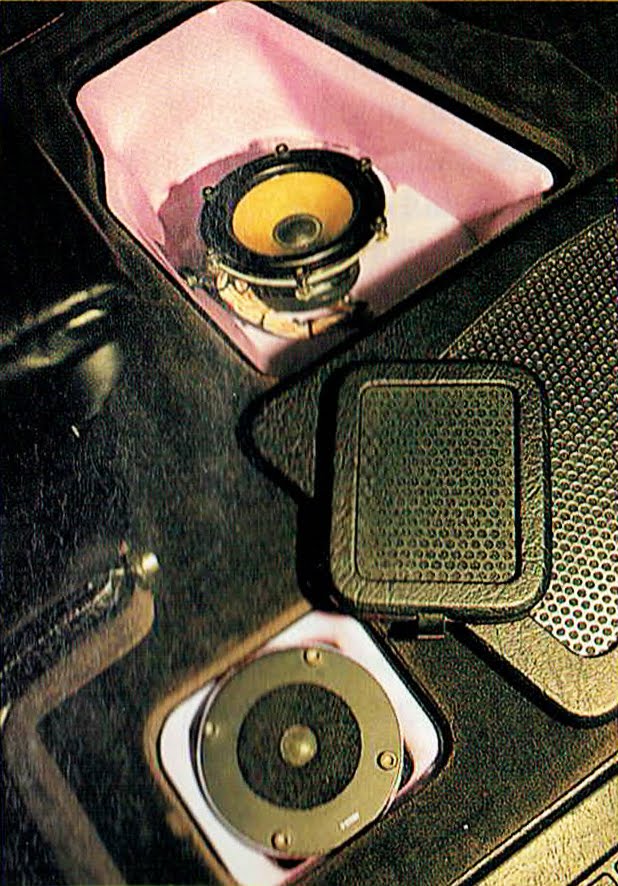
The two stars of the show are installed tricksters Alberto and Paul. They put it all together —first using the might of hammers, welding torches and angle grinders and then with the finesse of magnifying glasses, watchmakers tools in the steadiest hands in the bizz.
This van has the ability to demolish your bowels with its deepest SPL spank and yet delight you with the clear tones of SQ.
Let's start with the sound quality install. The system is mounted into the Yank tank's floor and has a total of six speakers —a pair of tweeters, a pair of 5in mids in a pair of centrally mounted 8in bass speakers. These are all Eton components, but some have been modified —like the tweeters, which had been stripped and had the internals drilled to smooth out the airflow and then stuck back together for the ultimate sound. At the extreme, but then you have to listen to the damn thing to realize how well it works. I sat and listened to Yellow—The Race and he felt like I was there, in the studio, listening to the guys recording the whole thing.
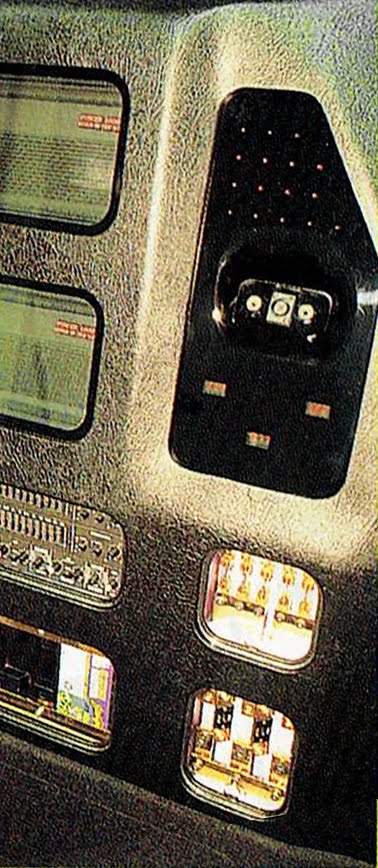
There's so many mods to this van, we could spend a whole issue just talking about it. Tricks like using multiple wires to pump sound to the speakers actually work and reduce noise. The cooling system for the rear amp racks blow more like our air conditioning at the height of summer.
The perspex speaker mounts for the SQ system are unbelievable and are completely perfect and blemish free. I've seen install guys have more trouble with vinyl and these guys had with this inch thick perspex.
And what about that power supply? Running four 1200W amps for SPL is going to draw more current than a bumper episode of Coronation Street. You won't be surprised to learn that he took 7 hefty blokes to lift the battery rack into position. Even then, it was only lifted about three inches at a time, using bricks to hold it up. Jeeze. Sadly, we can talk about all the details, so you'll have to trust me to pick out the best parts. Hey, trust me!
You could be easily excuse for losing the head unit. That's 'cos there isn't one, not in one piece anyway. That Fujitsu Ten unit was stripped, slaughtered a mounted all over the van's cabin. Sure, the display is behind the perspex panel in the dash, but the CD player itself (just the mechanism and the gubbins) is practically in the floor. Tiny cables have been attached to the controls and, via a set of relays, control the unit through the armrest-mounted panel. This itself has been screen-printed with a host of it easy-read symbols. It's all designed for ease of use, but changing a CD on the move could end in tears as you have to bent double.
The SPL content of this van is extreme. Pact between the front seats and the rear battery rack are 16 of Earthquake's LS-15 subs. These are mounted in a twin-diamond arrangement and are activated by a the massive bank of dash-mounted switches, while four 1200W Lanzar amps pump up the volume to a head-splitting level.
To activate SPL mode you have to set the van up. Strap on the screen bars, lock down the doors, plug-in the external head unit and equalizer and it's time to step back. Boom? Damn right it does. It booms enough to make the alarms on cash machines go berserk, and that normally takes an attack from JCB. When the police turn up a couple and start asking questions, the demolition van switches from SPL to SQ and stealthily slides away. A class act.


Ice Spec
In-Car Entertainment's ICE Van


System Diagram
SOUND SOURCE: SQ and Cruisin' systems —Fujitsu Ten CD/tuner stripped and dispersed around the dash with external switching; SPL system—external Alpine 7909 (yes, a real old 7909) CD/tuner with Hifonics Callisto EQ, all mounted in a drum stool (Eh? —JS)

AMPLIFICATION: SQ and Cruisin' systems —2x modify the Earthquake class 'A' 2x30W amps; SPL system—4x Lanzar OPTi-50c.

PROCESSORS: Some

SPEAKERS: SQ system —2x modify Eton tweeters, 2x Eton 5in mids,2x Eton 8in subs; Cruisin' system —15x Lanzar tweeters, 8x Earthquake 5in mids; SPL system —16x Earthquake LS-15 subs

CABLES: Stinger cables throughout the system

POWER SUPPLY: Switchable twin alternator system to feed the front and rear battery racks as necessary

CAP: lots

INSTALLED BY: Tricksters Paul and Alberto

NICE IN STILL BITS: The microwave switching sensors, the Kenlowe fan for the ventilation system, the Chevy engine, the perspex, the tits on the side of the van... Basically, the whole damn thing is bad as bad can be

PERFORMANCE: Well what do you think, huh?

THANKS AND FREE PLUG: Paul and Alberto for a magnificent install; Mark at In-Car Entertainment on 0181 743 5533


Max Power Magazine Cover
December 1997
Max Power Magazine Pages 54 & 55
December 1997
Max Power Magazine Pages 56
December 1997


Thursday, August 10, 2017

From Mississippi to Nebraska

Surprised, I said "what the hell are you guys doing there?" I opened the garage's overhead door when I saw the two guys who had just left their car for me to work on the day before. This was a custom installation that would take many days. So when I saw the them coming out from behind a tree, in the middle of the Nebraska winter, at seven in the morning, I was stunned to say the least. The two guys told me they had slept outdoors the night before. "The whole night?" I asked. They went on to explain that they had no money left for a hotel. These guys had come from Minnesota for me to work on their car and had spent all the money they had on my work. I couldn't believe it.
I know it sounds crazy. So if you don't believe it either, I don't blame you. But the truth is that, during the golden years at Stereo West, I had people come from very far away. They were looking for help. While some needed complete installations, the best and most notable vehicles needed my help for two things: either eliminating noise or completely overhauling their sound performance. These special vehicles already had elaborate installations by some of the best craftsmen in the industry. Yet, my reputation for having the understanding of the physics behind sound quality and for sporting a pair of golden ears, meant that I got an exclusive opportunity to peek behind the scenes of incredible sound systems.
picture of John Stubbs in front of his 1993 Toyota 4x4Such was the case with John Stubbs. I guess he had taken a sabbatical from the police force in Mississippi  to come to hang out with us to Nebraska. It is very easy to like John. He's an honest, transparent, and charismatic guy with a great sense of humor. The time we spend together was very memorable indeed.
Before heading our way, John had the guys at Pro Audio in Mississippi build an incredible instal for his truck. The system had the USAC solid construction blended with the IASCA beauty. But many trucks are notably difficult for good sound quality performance; especially those where you stuff a huge woofer box behind the front seats.
This was a different era in sound quality. The midget-sized-instruments on top of the dash that are so common today were not acceptable back then. Today, poor judging describes such affect as good imaging specificity. Back then, we just called it what it is: funny midgets on the dash; not real music.
picture of John Stubbs' kick panel inside of his 1993 Toyota 4x4, with protective grillsWe were looking to achieve large, realistic images over a well-defined stage. While kick panels can get you close, there is only one kick panel layout that takes into consideration the low-pass  phase-lag created by crossovers. If you look close at most of our competition cars, you will see such magical layout. I once looked into patenting it before I realized it would be expensive with no reward from the effort. I believe that the only other high profile competitor ever to use a similar setup was Chad Klodner in his incredible red Mustang.
picture of John Stubbs' kick panel inside of his 1993 Toyota 4x4, without protective grillsAfter changing his front stage for our magical kick-panel set up with built in a-periodic enclosures behind the mids, the mid-bass image kept giving us trouble. Mathematically, it takes only a simple calculation to see that midbass in the doors will tend to cancel with a wide 'Q' centered around 250Hz.
picture of John Stubbs' door panel inside of his 1993 Toyota 4x4, without protective grillsSo I decided to borrow a positive characteristic of waveguides: energy dispersion control. I theorize that mounting the midbass drivers backwards would make their sound disperse in a similar fashion to convex domes with phase plugs in front of them.
picture of John Stubbs' door panel inside of his 1993 Toyota 4x4, with protective grillsEveryone remembers the 3/4" titanium MB Quart domes that could produce 20kHz in any direction. I used to say that you could point them to the toilet and still get 20KHz on the RTA. Their performance results from their phase plug redirecting energy omnidirectionally. I was hoping that the magnet structure would do the same to the back of the cone of the mid-bass drivers in the doors. Incredibly, while the effect wasn't absolutely perfect, it did a very good job. It was the best midbass set up I ever did on a door.
Yet, I must admit that I never again placed midbass speakers on the doors. I have a hard time settling for almost good enough. At the end of the day we all learn from what we do. I loved working in John's truck. Looking back, I can comfortably say that I feel privileged to have met him.
Following is a transcript of the feature article on his struck as it appeared in the annual '96 edition of Mobile Sound Competition. Enjoy!


High Roller
Mobile Sound Competition '96 Annual 
Staff Writer

picture of John Stubbs' 1993 Toyota 4x4When you think of USAC competition, think of John Stubbs of Florence, Mississippi. He and his 1993 Toyota  4x4 have been making quite a ruckus the last few years in USAC circles, and it looks as though he's ready to make more noise in '96.
When John first got started in a Novice competition in 1992, he knew that this was his gig. He teamed up with US AC competition masters Pro Audio in Richmond, Mississippi, to integrate a no-holds-barred competition system that later proved to be the ring leader.
picture of the back of John Stubbs in front of his 1993 Toyota 4x4, with motorized back window open and motorized amp rack open
John Stubbs diamond-plate "toolbox" houses four amplifiers 
—two Kicker 200si's and two 50si's.
A seemingly simple equipment layout was chosen with components from Clarion and Kicker. Clarion's Pro Audio 7770 was installed in the dash and sends its signal to a Clarion 920 EQ in-dash 9-band equalizer. Two Kicker 200sI and two 50si amplifiers were installed in the bed of the truck in what appears to be nothing other than a simple, diamond plate tool bin. A look inside, however, reveals that it is a center of electronics and amplification.
picture of behind the seats inside of John Stubbs' 1993 Toyota 4x4 truckWhile you're looking in that area, look at what lurks on the cabin side of a motorized sliding back window: Kicker SoloBaric 12-inchwoofers highlighted with red neon are sure to get the attention of any judge. Another attention getter is a unique installation of the mid-bass drivers in the doors. Kicker R-4 speakers are mounted backward in the hope of reeling in a couple of extra creativity points. The sound isn't affected by this arrangement, according to John, since the basket is "open" and the build-outs are non-obtrusive.
John's hard work earned him a runner-up award at the 1994 USAC Finals and both the highest IASCA regional and USAC national points leader in 1995 —in all totaling nearly 50 trophies in a few short years. Though a team to be reckoned with, John has decided to part with his "toy" after the '95 USAC Finals to build something new with installers Greg Pauley and Alberto Lopez of Stereo West. In the meantime, you can expect to see John at the events —judging and being his usual enthusiastic self about this great sport.


Image of cover page of Mobile Sound Competition's Annual '96 Winners edition
Cover of Mobile Sound Competition's
Annual '96 Winners edition


Image of page 46 of Mobile Sound Competition's Annual '96 Winners edition
Page 46 of Mobile Sound Competition's
Annual '96 Winners edition
Image of page 47 of Mobile Sound Competition's Annual '96 Winners edition
Page 47 of Mobile Sound Competition's
Annual '96 Winners edition


Wednesday, July 26, 2017

Couldn't have happened to a nicer guy.

picture of Dustin Culton and his 1990 Red Honda Civic
Dustin Culton and his '90 Honda Civic
And suddenly catastrophe happened. This wasn't the first, nor the last time that one of our team cars had been stolen. Doing incredible car audio made is immediately recognizable and gave us great notoriety. I once took my Sentra to the Nissan dealership for a checkup and the service guy asked me if I had a system in it. He then followed on to tell me that Alberto Lopez had already designed a system for his car and would soon start doing it. I then asked him if he knew who I was. He replied with a question and an embarrassed look: you are Alberto Lopez? Yes, a never met the guy before, but I had somehow designed a system for a car I had never seen. It was funny.
picture of Dustin Culton's 1990 Red Honda Civic's engine compartment
A beautifully clean engine compartment
But with the accolades came the constant threat that our vehicles could be vandalized or stolen. Many outside of car audio may not immediately understand that the worst people among the bad guys love great car audio. So it was always a matter of time before one of us in the team would let their guard down in a car would be stolen. But this couldn't have happened to a nicer guy. When Dustin told me that his competition Civic had been stolen (read here about Dustin's previous system), he was heartbroken. Thankfully he had great insurance and some savings. So, as soon as the claim was settled, Dustin started on his next project.  He knew exactly what he wanted; from the type of car, to the color, to the audio equipment brands, to the overall fit and finish. Dustin was a mad man with a mission.
His fantastic efforts were published by Mobile Sound Competition's special edition Annual '96 Winners magazine. Following is a transcription from that memorable edition. Enjoy!


Si-Si-Si
picture of Dustin Culton's 1990 Red Honda Civic's driver side interior
Dustin Culton got his slick Honda Civic
when his last set of wheels was stolen.
Mobile Sound Competition's Annual '96 Winners edition
By: Staff Writer

What do you do when your car and competition stereo get ripped off? First you cry, then you get over it. You get another car and make the next system even better.
Sounds like something that will typically happen in LA., but it actually happened to Dustin Culton in his home land of Omaha, Nebraska. It wasn't pretty, but it did get him his 1990 Honda Civic Si, and he is now well on his way to a successful year in IASCA and USAC.
picture of Dustin Culton's 1990 Red Honda Civic's passenger side interior
The dash is stock, and hidden beneath
the passenger seat is a Phoenix Gold EQ.
Dustin's main concern when he put together his stereo (mostly by himself, we should add) was to make it as bulletproof as possible. That's because he drives the Civic every day, and Nebraskan winters can really wreck havoc on a car.
With only minimal body modifications, he is clearly succeeded. The dash is all still stock, with only a Sony CDX-900 added as a source. The kick panels have been massaged to house 5-inch Morel mids and Focal tweeters. Hidden under the passenger seat is a Phoenix Gold EQ, and under the driver's seat is a toolkit.
picture of Dustin Culton's 1990 Red Honda Civic's rear interior
Because there wasn't much space behind the Civic's rear seat,
Dustin surrendered his spare tire to his Rockford subs.
Civic hatchback's don't have a whole lot of space behind the rear seat to fit subs, and as Craig (Dustin) couldn't part with any of them, he gave up the spare tire. He installed a pair of Rockford Fosgate 8-inch subs, and he and Alberto Lopez plugged up the bottom of the tire well with an Aperiodic mat to make the subs think they had just the right amount of air space. All told, he still has 90 percent of his hatch space for his stuff.
Starting over is something easier than lumbering on with the old. For Craig (Dustin), paradoxically, having his cars swiped turned out to be a great move —for his competitive edge that is.


image of Mobile Sound Competition's Annual '96 Winners edition page 78 covering Dustin Culton's 1990 Honda Civic
image of Mobile Sound Competition's Annual '96 Winners edition cover page


List of installers and equipment in Dustin Culton's 1990 Civic

Wednesday, March 30, 2016

Bad Judges or Bad Reference - Part II

I feel I need to further explain why is it that the Spring Break Nationals cars I heard were so bad?

composition image in four parts. First, micro musicians in front of larger microphones on a white stage. Second, micro musicians on top of a car dash serving as their stage. Third, real sized musicians on top of a car dash serving as their stage. Fourth, real sized musicians in front of microphones on a white stage.
Which is the real stage and which has the midget-sized musicians?
While there are a few other reasons, I will take a look at one property of sound reproduction that comes close to my heart; one that makes a big difference in the realism heard from the system.
In a nutshell, I am talking about designing a system with a very good step response. Read my previous posts and you will inevitably come across many mentions of the importance I place on this acoustic measurement. Good systems have a great step response and mediocre ones don't. It is a fact that remains independent of whatever else is done in the frequency/amplitude domain.
But why take my word for it? Why not look at what others comment, when unprompted.
Image of Quad ESL 989 electrostatic speakers inside a living room with many pink accents
Quad ESL 989
The one place where you can reliably get both, a good sound review and good measurements is Stereophile magazine. While it could be argued that The Absolute Sound or other international publications are superior at gauging realistic reproduction, none of them do measurements at the level of Stereophile. To me, the art must be matched by the science. Furthermore, the fact that Stereophile has many years of historic record keeping means that we can come up with some sort of statistical mean relevant to any kind of measurement.
Let's take two speakers from well regarded makers. Neither pair is cheap by any stretch of the imagination. Yet, one resides within the mid-fi world while the other sets foot inside the real high end.
I am referring to the NHT 3.3 and the Quad ESL 989 respectively. Yes for this comparison, I selected speakers that had been around a long time with the hope that most people would have heard of them.
The pair of new NHT 3.3's sold for about $4,000 while a pair of the Quad ESL 989's commanded a price tag of around $8,000. Such a small difference in price, yet worlds apart in performance.
NHT is generally a solid mid-fi speaker maker. Their products have seen strong following and plenty of industry accolades over the years. Still, theirs was never an attempt at the absolute state of the art, no matter what their marketing materials would claim. The fact remained that their path of choice was always one that kept them away from using the best components or having great enclosures. I remember a time when I did my usual ear-to-the-side-of-the-box test and was horrified by the loud ringing the speaker cabinets made. No high end manufacturer would ever allow for such large amount of energy to be dissipated in a poor and unpredictable way within the room. I also recall their engineers acting like I had just farted after I cringed from the disappointing experience.
image of black NHT 3.3 speakers inside a room with many wood accents.
NHT 3.3
But the real test, as always, is the listening session; an event that would further disappoint. While the speakers were bright and dry, what really told me the story about their heritage was how compressed the sound's physical dimensions were. The height of all instruments was ridiculously small. Depth was none and width was definitely inside the speakers; a fact that seemed difficult to conceive after taking in consideration the speaker's narrow cabinet profile, the asymmetric mid and tweeter placement, and their use of a felt strip next to the drivers. In other words, the engineers must have worked extra hard to make a speaker sound that bad considering how many other good things were going for it.
But enough of my opinion. Stereophile's Thomas J. Norton reviewed a par of NHT 3.3's for the magazine in 2005, after the brand had been acquired by Rockford Fosgate but before it was divested in October of that year. Believe me, it's a long story.
While the speaker received a good "B" rating by the magazine, Norton found it necessary to mention the following:

My rendition of a horrible Step Response curve on dark gray background of NHT 3.3 Speakers as publushed by Stereophile Magazine
"The 3.3s' soundstage was tight and focused, accommodating the program material both in the precision of its lateral detailing and in its depth. On some recordings there was noticeably less depth and pinpoint imaging than with soundstage champs like the WATTs/Puppies. But on others—the organ on Dorian's Pictures at an Exhibition, the synthesizer, vocalist, and chorus on Enya's Watermark (Geffen 242332), and the instrumental and vocal interplay on Eric Bibb's and Cindee Peters' Opus 3 compilation (CD 7706/03) jump off the pages of my listening notes—the depth rendition and lateral focus were all I could have hoped for. The only drawback I noted was a limiting of the soundstage to the space between the loudspeakers."


While the speaker played tones correctly, Norton made reference to the same kind of midget-image effect I described when talking about the Spring Break Nationals cars in my previous post. I mentioned that these cars tend to play ping-pong between the right and the left in such a way where the sound never goes past a very sharp boundary. It is also what makes some judges positively comment on how focused images are. Believe me, if instruments were midget sized, all the concentration of energy would always make them seem focused. But this effect is a distortion rather than a positive.
No, these weren't the only problems with the, so called, great cars. So hold back on your desire to jump to conclusions on the unfairness of my disappointment with cars that did some of what a mid-fi speaker do. Believe me, these cars don't come close to even the NHT's. But it is the flaw of compressed physical dimensions that I want to call attention to.
The distortion is so damaging to the reproduction that even Norton saw the need to compare the NHT's poor performance to that from the Wilson Audio's. I guess that great minds think alike.
And what's the reason for such dimensional distortion? Well, a poorly designed crossover network; one where part-count and cost are more important than performance. Take a look above at the impulse response as published by Stereophile in the same article. Each swing up or down is literally destroying the dimensional accuracy of the sound across progressively longer wavelengths.
Now, for the good news. Let's focus our attention on the Quads. The brand has been around for a long time and it is well known for making speakers of all sizes of an exceptionally predictable high quality. In my opinion, they simply never disappoint; even when considering that many electrostatics are notoriously difficult to set up.
In 2002, Larry Greenhill said the following when reviewing the Quads:


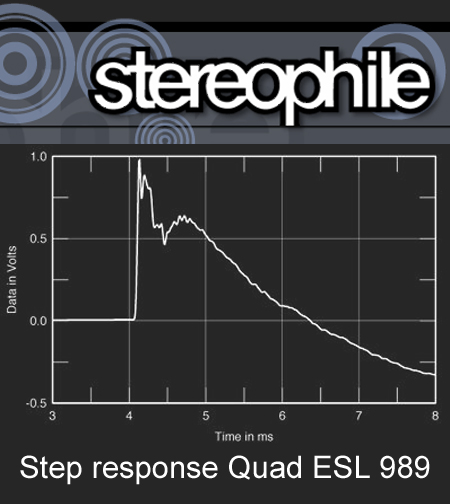
My rendition of an almost perfect Step Response curve on dark gray background of Quad ESL 989 Speakers as publushed by Stereophile Magazine
"The ESL989s' imaging was topnotch, conveying a seamless, wall-to-wall soundstage that did not seem to emanate from the speakers themselves. They captured the soundstage depth and width of "Naris," from Patricia Barber's Blue Café (CD, Premonition/Blue Note 5 21810 2). Percussion was open, airy, fast, and transparent. José Carreras in Misa Criolla was startling, his soft tenor in the foreground, a large, muted drum playing deep and to the left of center stage, backed up by the large, distant chorus. The perspective was spacious and eerie, suggesting the desolation and emptiness of a high South American plateau. Suzanne Vega seemed to materialize between the two ESLs, close enough to touch, as she sang "Tom's Diner," from Solitude Standing (CD, A&M CD 5136)."


Interestingly, there was one car that created a sound that could have been described by Mr. Greenhill's comments. But do you think that the show judges were able to recognize it's exceptional nature? No (in case you were looking for an actual response).
There is something pervasive about the soundstage of speaker systems with a triangular-looking step response. They are all big, rounded and well defined; whether from back to front, side to side or top to bottom. They are as close as space reproduction comes to being real. For God;s sake, just close your eyes and pay attention the the most basic of sounds. Don't be surprised if you don't find midget images anywhere.
Illustration of an almost perfect step response over a dark gray backgroundFor your reference, I am also sharing a model-based graph that illustrates the theoretically perfect step response.
So, could it be that the car that I am making reference to as having "conveying a seamless, wall-to-wall soundstage that did not seem to emanate from the speakers themselves" also has a triangular step response? Yes. This is something that any sophisticated professional listener should be able to easily recognize. Clearly there is no hope for the show's judges.
If you have any doubt, it takes an exponentially better engineer to design a system that does a good step response on top of doing everything else right. So, awarding a point or two of separation between the cars that do it and those that don't is simple wrong. A point or two are linear in nature while the performance difference is, again, exponential. This explains the exponential difference in price between the home speakers that achieve it and those that don't.
I remain terribly disappointed that Spring Break sound judges:

  • were not able to identify vehicles with compressed dimensional reproduction,
  • didn't know the exponentially higher value of achieving uncompressed dimensional performance,
  • and were not able to recognize the superior and more natural sound that comes from a well designed system. 

Tuesday, March 22, 2016

Bad Judges or Bad Reference?

In sound-offs many sound judges act as if they possessed a sound reference; an absolute reference to the sound being evaluated. They tell you that they know what the singer sounded in real life or that they know the band playing. Yet, these same judges fail time and time again when faced with exceptional sound. 
Why? Because their reference is flawed. They have been listening to too many cars, for one. A recent visit to the Spring Break Nationals event in Daytona demonstrated that most cars sound like not much more than a well tuned boom box. Yes, they are boxes that generally lack any sort of coherence when attempting to keep the projected image of an instrument in the same space and within the same dimensions. Even timbre changes as musicians shift up and down the spectrum of their instruments, making it seem as if multiple kinds of instruments are being played by the same musician.
So, why is it that these judges can't tell the flaws? Well, because they try to judge sound as if it was a point on a map. Once you get to that  point, your sound is good. But an absolute sound is not a point. If that was the case, one of the two recordings in this video would be absolutely correct and the other absolutely wrong. Yet, both are correct.

A good sound judge would know that. Both recordings can in fact be reproduced equally well. But fantastically well would never mean that the sound seems to be within a little box, which is what the so called best cars in the world sound like.
I suggest that these judges try to go to their nearest Wilson Audio dealer ASAP. They urgently need a reference. If the sales person actually let's them audition the speakers, they will hear how different these sound when compared to "the best cars in the world".
I have nothing for or against the Wilson brand, other than I wish they were much cheaper. But Wilson makes a fantastic family of speakers that are not spatially limited as are all other mid-fi brands. Of course that there are other good brands (Vandersteen, etc). Look for speakers with great step and polar responses and don't get too worked up with tonality, which any boom box with a thirty band equalizer can do ok with. But do consider the Wilsons. I just think that Wilson's focus on tuning their dealer shops pays big dividends every time.
But why not just listen to real music played life? Well, much of today's music is amplified, which means that you are at the expense of the many audio engineers with severe hearing loss that rule the world of pro-audio.
Now that if you have the time and the passion for listing to life unamplified music, then be my guest. Nothing compares to it. Professional musicians work harder than anyone I know and deserve the patronage. Just keep in mind that the actual reference that you will build will not be a single event or a single point on the map, as I made reference to before.
Instead, the real reference will be the memory of the beauty that real sound becomes.
Also, remember that to create such beauty, professional musicians have to make an exponentially larger investment. So, when listening to reproduced sound that captures the bigness and the nuances of their work, also acknowledge the exponentially larger investment required to achieve it.
In a nutshell, I think that today's sound off judges don't have either the knowledge or the guts to reward real high performance audio when they hear one. This is a shame because the tens of thousands of dollars invested by sound off competitors are being gambled through a random lottery system. It's all a real shame.

Monday, August 31, 2015

Jay's Escort - Real British Pride

Want to see more? Check out Jay Bow's Max Power article and then click on the video. But before, you may want to read my previous post about Jay Bow's family.


These images are from the pages of Max Power:


All pictures are property of Max Power Magazine and are used exclusively for educational purposes.

Saturday, April 18, 2015

Low Stage Part 02 - A case of Lobing

At the very least, matching tweeters mounted on the "A" pillars with mids installed in the kick panels is a terribly risky idea. 
Why, then, is it that so many cars use the technique so successfully? Well, it all depends with what you call successful.
In Low Stage Part 01 - Two Speakers, I tackle some of the myths about fixing perceived stage height. In this second part I will further comment on the challenges resulting from the system's lobing patterns.
Sound judges today, seem to have forgotten that live music is large. Instead, they award higher scores to systems projecting caricature-like images. The more violins seem minuscule in size, the sharper the image these judges think it to be.
image of a mouse playing a miniature bass on top of a car dash
Miniature Instruments
These judges equate small with sharply outlined. But image sharpness comes from transparency rather than size. It is only after removing many layers of veil that we get to see the difference between the suspended instrument and the empty space around it. Closing our eyes while listening to great quality unamplified music demonstrates this. But if asked whether these sound judges routinely listen to real unamplified music, the response is that of an empty stare. Just think about it, even the Boston Pops amplify most of their performances. It is getting harder and harder to listen to the magic that comes from real good musicians playing real good instruments without ElectroVoice ruining the presentation.
I remember going to listen to Sarah Brightman. The beautiful lady captivated me from the moment I first listened to her music. So, when I had a chance, I paid for the tickets. Armed with excitement, I listened attentively. So can you imagine my surprise when her sound was flat and brittle? It was terrible. Whatever the sound engineer was doing, I hoped would end immediately. Surely his acid trip and the loss of high frequency sensitivity made it impossible for him to understand what good sound was. But then again, maybe I was being hypercritical. Then came intermission. As the lights came on, dozens of people around me begun to complain about the terribly bright sound. It seems I was not alone in my conclusion that the sound sucked. How sad indeed.
The bottom line is that when asked about how to earn critical listening skills, I tell people to just listen to real music. It is that good when compared to the garbage we are now exposed to.
When I audition a system, I pay lots of attention to the size of the instruments. Properly aligning speakers will inevitably result in larger, deeper images. It is this quest that makes me conclude that most systems with speakers on the "A" pillars fail the time domain test. While placing  speakers like tweeters up high helps with the perceived image height, it does nothing to create realistically sized instruments. Have you ever listened to a grand piano. The sound is as large as a room. But most car audio systems, even the better ones, shrink instrument dimensions in the pursuit of so called image definition as they define it.
On the other hand, a system using properly time corrected speakers will do both, large instrument size and solid image height. It is interesting to note that the time correction I am referring to is independent of speaker positioning. In other words, I am not against speakers on the "A" pillars. I am against using them as a way to patch fundamental problems without properly addressing such issues directly. Most system designers path their height issues and completely miss the fact that inadequate time response has killed any hope at realistic image dimensions. Soon a self fulfilling prophesy is created where judges begin to reward poor performance with higher scores because of herd behavior.
At a recent Consumer Electronics Show, I spent time with my friends Chris and Melissa Owen at their high end room. Orca had lent them speakers sporting their latest design. To be clear, the speakers looked fantastically finished. Moreover, these deployed really good drivers from Orca's arsenal. But as soon as Chris fired up the system for me, I told him that the crossover had problems that were creating comb-filtering. It seems as if the designer, like many others within the industry, used 12dB/oct parallel crossovers between drivers mounted on a surface that stood perpendicular to the floor. Anyone who pays attention to this stuff would know that this was trouble waiting to happen. But for the many who think that amplitude linearity is all that matters, the speakers were fine, just as their LEAP modeling software had predicted. So, as we move onto the car, consider that the problems I will address are also ubiquitous in home speakers. Again, it's a bit of a herd problem.
I recently showed a dear friend what happens when a tweeter on the "A" pillars is matched with midrange speakers in the kick panels. I used modeling software that is freely distributed. Oh, how I wish I had these tools when I started in the industry. Back then I had to interpret all the multidimensional variables while trying to make sense of what I was listening. I used no equipment when designing passive crossovers; just my trusted ears.
Polar response for tweeters in "A" pillars and mids in kick panels
 Take a look at the illustration above. It models what the polar response would be for a system with a tweeter mounted on the "A"pillars while the mids are in the kick panels. The crossover uses a 12dB/oct sloped at a frequency of 3.5KHz. Note that both of these settings are quite common in the industry. As it should be immediately evident, destructive interference would make it very difficult to find a listening position where spectral performance could be maximized. Just move your head an inch or so and all dimensional sense will evaporate. This kind of lobing error seems to correlate with poor vertical spread or instrument size; no matter whether in a car or a home system. In fact, one is often surprised of how many so called high end speakers display poor polar response. For many of them, tilting the speaker backwards would solve the issues. This explains why there are so many speaker platform designers that facilitate just such tilt without risking that the speakers fall backwards. It is an expensive way to correct what could otherwise be handled at the design stage. Unfortunately, the problems depicted here are much more gruesome. No amount of tilt will fix them. Either the distance between the drivers needs to be reduced or the crossover point should come down in frequency by quite a bit.
Polar response for tweeter and mid in kick panels
Now look at the second illustration for what happens when both drivers are located side by side to each other in the kick panel. Crossover frequency and slope remain the same. The only aspect worth noting is that to fix the problems associated with the 12dB/Oct design the tweeter has to be physically located on a plane behind that of the mid. This helps til the lobe upwards to ensure that maximum spacial performance occurs anywhere a common listener would place her head.
And if in need of further clarification, the second set up would also project images at eye level. The main difference is that images from the latter setup would be much larger, just as God intended.
Polar Response at 10KHz between
tweeters in the "A" pillars and kick panels
Again, I am not saying that height is wrong when using tweeters on the "A" pillars. I am simply clarifying that by themselves, they are no solution. The same attention to detail needed for properly setting up speakers in the kick panels will be needed with speakers mounted above the dash. Furthermore, to prevent the negative effects from comb-filtering, a less common slope should be matched with a lower crossover point aside from proper time adjustments.
And while we are on the subject, what do you think happens wen people use both drivers in the kick panels and then add a second set of tweeters on the "A" pillars to "lift" the sound. Often, well intended attempts use a higher frequency high pass filter for the tweeters mounted above the dash. Well, chaos is what happens. Look at the illustration to the left. It represents what happens at 10KHz with a 6dB/Oct highpass slope for a tweeter mounted on the "A" pillar and matched to a tweeter in the kick panel. It begs the question of how in the hell would one expect reliable performance; forget about good sound, just getting the same sound all the time would be a bonus.
Can anyone hear the difference? Yes. Can anyone know what's wrong with the music? No, In simple terms, the change is visceral. We just know it's wrong. These types of problems tend to fatigue us quickly.
Are the issues discussed correctable? Yes, but only when the constraints are understood. Unfortunately, many industry designers miss the science side of sound and attempt to solve everything as if it was all an art. While music is certainly an art, we should not waste valuable creative time on things better left to our tools. I hope you found this post as helpful.